Shower Remodeling Options: How to Choose the Right Design for Your Bathroom
June 8, 2026
The grout has gone gray, the pan flexes underfoot, and the door seal peels back every time you close it. You have been tolerating it for two years and finally decided something has to change. The problem most homeowners run into at this stage is not motivation; it is the overwhelming number of options and no clear way to evaluate which one actually fits their bathroom, their habits, and their house. After 22 years of
shower remodels across South Park Township and the surrounding Pittsburgh area, the clearest advice we can give is this: the right shower design is defined by how your bathroom is built, not by what looks good in a showroom photo.
Start Here Before You Make Any Decisions
Before you commit to a layout, a material, or a contractor, work through these steps:
- Measure your current shower footprint and the rough opening dimensions. A standard shower requires a minimum of 36 by 36 inches, but 36 by 48 inches is the practical minimum for comfortable daily use. Anything smaller than 36 by 36 inches will not meet current IRC code requirements.
- Locate your drain position. A center drain, corner drain, and linear drain each demand a different subfloor slope and waterproofing approach. Changing drain location adds scope and time to any project.
- Check your water pressure at the showerhead. Flow below 40 PSI will underperform with rainfall heads and body spray systems regardless of how well the fixture is installed.
- Confirm whether your existing walls contain moisture damage before any new surface goes over them. Press firmly along the bottom 12 inches of the surround. Soft drywall or tile that moves under pressure means the substrate needs replacement, not a new surface on top.
- Decide who uses the shower most and how. A household with mobility considerations needs different dimensions, bench placement, and threshold design than one optimizing for a quick daily routine.
TIP: Photograph your current showerhead, valve, and drain before any consultation. A remodeling professional can identify your existing rough-in configuration from those three images and tell you within the first conversation which design changes are straightforward and which require structural or plumbing work.
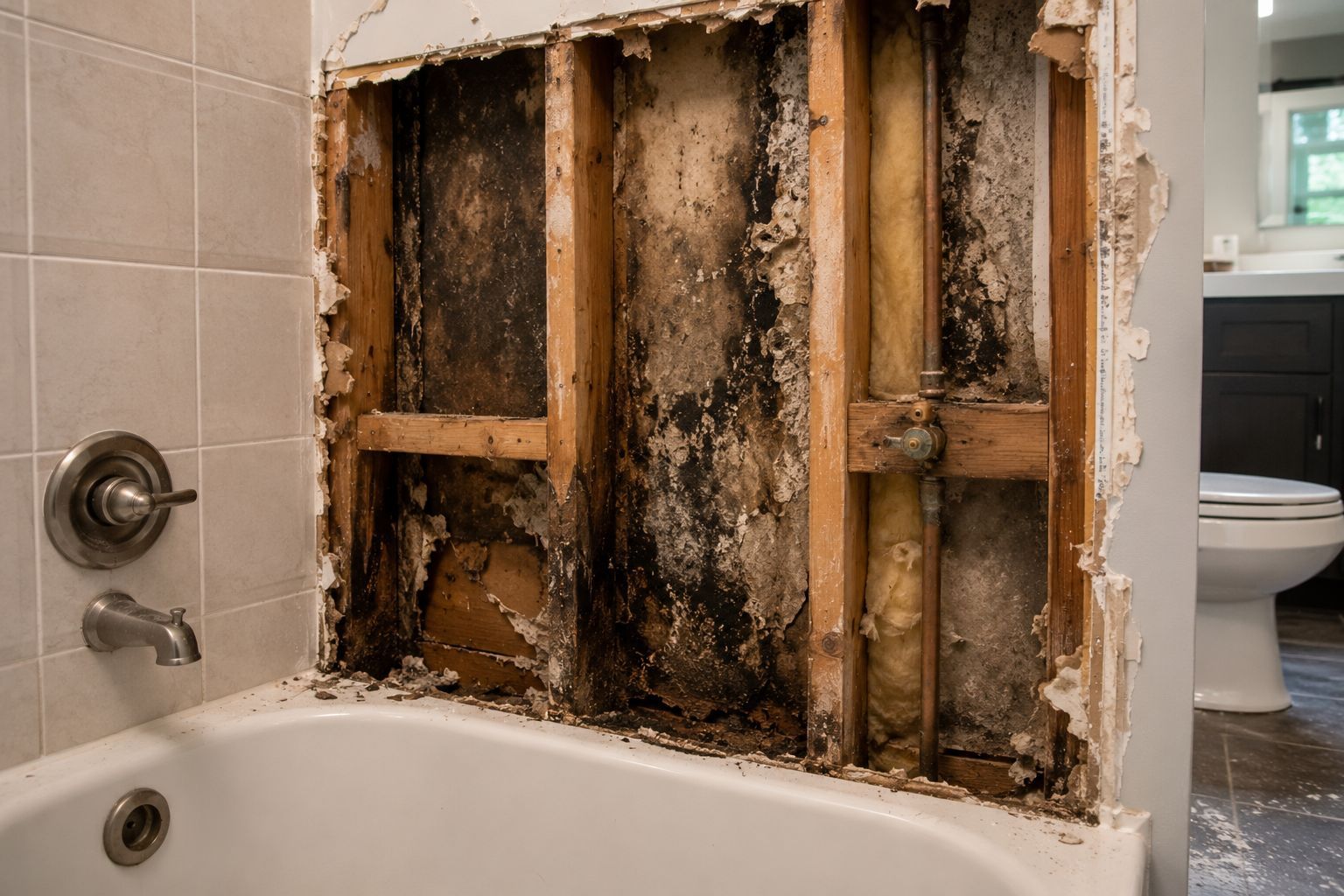
WARNING: If you see black staining along the base of your shower walls or detect a musty odor inside the stall, do not tile or panel over the existing surface. Black mold behind a shower surround indicates a waterproofing failure that has reached the subfloor or wall cavity. The substrate must be fully removed, dried, treated, and relined before any finish surface is applied.
Why Shower Remodels Fail Before They Start
The single biggest source of shower remodel problems is choosing a finish material before confirming what the subfloor and wall framing can actually support. Tile installations on a subfloor with more than 1/360 deflection will crack within 12 to 18 months regardless of how well the tile is set. This is not a workmanship failure; it is a physics problem that no amount of skill on the surface can prevent.
In South Park Township and throughout Allegheny County, homes built between the 1940s and 1970s frequently have subfloors constructed from single-layer boards rather than plywood panels. Those boards dry out, cup, and develop gaps over decades, creating a subfloor assembly that moves differently under load than modern construction. A shower system designed for a rigid substrate will develop tile cracks and grout failures within two seasons when installed over a flexible older floor.
Installation-related failures account for a significant share of callback work. Inadequate waterproofing at the curb, pan liner folds that are not properly bonded, and tile set with insufficient back-butter coverage on large format tiles are the three most common technical failures we find when diagnosing a shower that is only two to five years old.
Shower Design Options Compared
| What You Are Considering | Best Use Case | Key Limitation | Install Complexity |
|---|---|---|---|
| Acrylic or fiberglass surround | Budget remodel, quick turnaround | Scratches over time; limited customization | Low |
| Cultured marble panels | Seamless look, low grout maintenance | Heavier; chips harder to repair | Medium |
| Ceramic or porcelain tile | Custom look, high durability | Grout maintenance; rigid substrate required | High |
| Large format tile (12x24 or larger) | Modern aesthetic, fewer grout lines | Extremely flat substrate required | High |
| Natural stone tile | Premium finish | Requires sealing; heavy; cold underfoot | Very High |
| Walk-in curbless shower | Accessibility, open feel | Linear drain, sloped subfloor, precise waterproofing required | High |
| Prefabricated shower unit | Fastest install, tight spaces | Fixed dimensions; full removal to replace | Low to Medium |
| Steam shower enclosure | Spa experience | Vapor-proof ceiling, generator, dedicated circuit required | Very High |
How We Assess a Shower Before Recommending a Design
A professional assessment starts at the floor, not the walls. We check subfloor deflection by placing a straightedge across the floor and applying body weight at the center of the span. Any deflection greater than the span divided by 360 disqualifies standard tile without corrective framing work.
We probe the existing wall substrate at the base of the surround, paying close attention to the bottom 6 inches behind the curb or threshold. In South Park Township homes from the postwar building period, we frequently find that the original shower was built on standard drywall rather than cement board or a waterproof backer, and moisture infiltration extends several inches beyond the visible damage.
Drain position and condition come next. We check the drain flange height relative to the finished floor elevation to confirm whether the existing drain is compatible with the planned finish thickness. A tile installation that adds 3/4 inch of combined mortar bed and tile thickness to a floor with a drain set for a thinner finish will result in water pooling at the perimeter rather than draining correctly. Per IRC standards applicable in Pennsylvania, shower pans must slope at a minimum of 1/4 inch per foot toward the drain, and we verify this with a level before any new waterproofing is applied.
A surface refresh makes sense when the underlying structure is genuinely sound and the goal is updating appearance. A panel system installed over a dry, stable, plumb substrate can hold up for 10 to 15 years. But if there is any moisture history, subfloor movement, or question about the waterproofing beneath the existing surface, a refresh is a temporary fix on a permanent problem. In South Park Township's older housing stock, the second scenario is more common than the first.
Mistakes That Lead to Rework
Choosing materials before confirming the substrate. Material selection is the enjoyable part of planning a remodel, which is exactly why most homeowners start there. Large format tile, natural stone, and some panel systems have substrate requirements that older bathroom floors cannot meet without corrective work. Discovering this after materials are purchased adds delay and forces scope changes mid-project.
Tiling over existing tile. Setting new tile directly over old tile raises the finished floor height by 3/4 to 1 inch, which affects drain height, door threshold clearance, and the load on the subfloor assembly. Two tile layers can exceed the design capacity of older framing in South Park Township homes.
Skipping the uncoupling membrane. In western Pennsylvania's climate, an uncoupling membrane is not optional on floor tile. Seasonal movement in wood-framed structures will crack grout in a direct-bond installation within two to three heating and cooling cycles. The membrane eliminates the most common callback issue in tile shower work across the Pittsburgh area.
Frequently Asked Questions
How long does a shower remodel take?
A surface refresh with panels over a sound substrate takes one to three days. A full tear-out and rebuild with tile, a new pan, and updated fixtures runs five to ten business days. Projects that uncover subfloor damage or require drain relocation add two to five additional days. Build a buffer into any full rebuild plan from the start.
What is the most durable shower wall material for a busy family bathroom?
Glazed porcelain tile leads on durability. It resists scratching, does not absorb moisture, and holds its finish for decades. The weak point is always the grout, not the tile. Specify epoxy grout in high-use showers to extend the interval before regrouting. Cultured marble panels are a lower-maintenance alternative that eliminates grout joints almost entirely.
What causes grout to crack in a recently installed shower?
Almost always one of three things: subfloor deflection exceeding the 1/360 standard, no uncoupling membrane under the tile, or grout joints set too narrow for the movement conditions present. In western Pennsylvania, seasonal framing movement stresses direct-bond tile assemblies within two to three heating and cooling cycles. Regrout with flexible or epoxy grout after confirming the substrate is not still moving.
Can I keep my existing shower pan and just replace the walls?
Yes, if the pan does not flex underfoot and the drain shows no signs of leakage below. Recaulk the full joint between the pan and the new surround with flexible silicone rated for wet areas. If the pan shows crazing, staining that will not clean, or any soft spots in the floor, replace the full unit rather than the walls alone.
What shower size works for a small bathroom?
A 36 by 48-inch footprint is the practical minimum for comfort and code compliance in bathrooms under 50 square feet. A 36 by 60-inch footprint is noticeably better if the layout allows it. Curbless walk-in designs work in small bathrooms but require precise drain placement and subfloor sloping; they are not automatically simpler than a curbed shower in a tight space.
The Decision Starts Beneath Your Feet, Not on the Showroom Floor
The substrate beneath your shower decides the outcome before the first tile is set or the first panel is hung. In South Park Township and throughout Allegheny County, the combination of aging postwar housing stock and western Pennsylvania's seasonal humidity cycle means substrate problems are more common here than in newer construction markets, and they are almost always worse than they appear from the surface. River City Bath
has been diagnosing and remodeling showers across South Park Township, Bethel Park, Jefferson Hills, and the greater Pittsburgh south suburbs for 22
years. Call us for an on-site assessment before you commit to a material or a design direction.